


Skip to content

Organisational Coherence

Why do capable organisations still pull against themselves?

Strong individual contributions do not automatically add up to a strong whole. Organisational Coherence emerges when people and systems reinforce one another, enabling the organisation to work effectively as a whole.

Recognise this?

Priorities compete. Work is repeated. Individual departments improve their own results while the organisation as a whole struggles. Decisions vary between teams. People repeatedly have to put in extra effort to compensate for persistent problems in how the organisation works.

Coherence does not require everyone to think or behave alike. It emerges when purpose, people and systems reinforce one another, enabling different perspectives and capabilities to contribute to shared direction and coordinated action.

Definition

Organisational Coherence is the emergent state in which the Designed Organisational System and the Living Human System reinforce one another, connecting purpose, people and systems so that intent translates into coordinated action and sustainable performance.

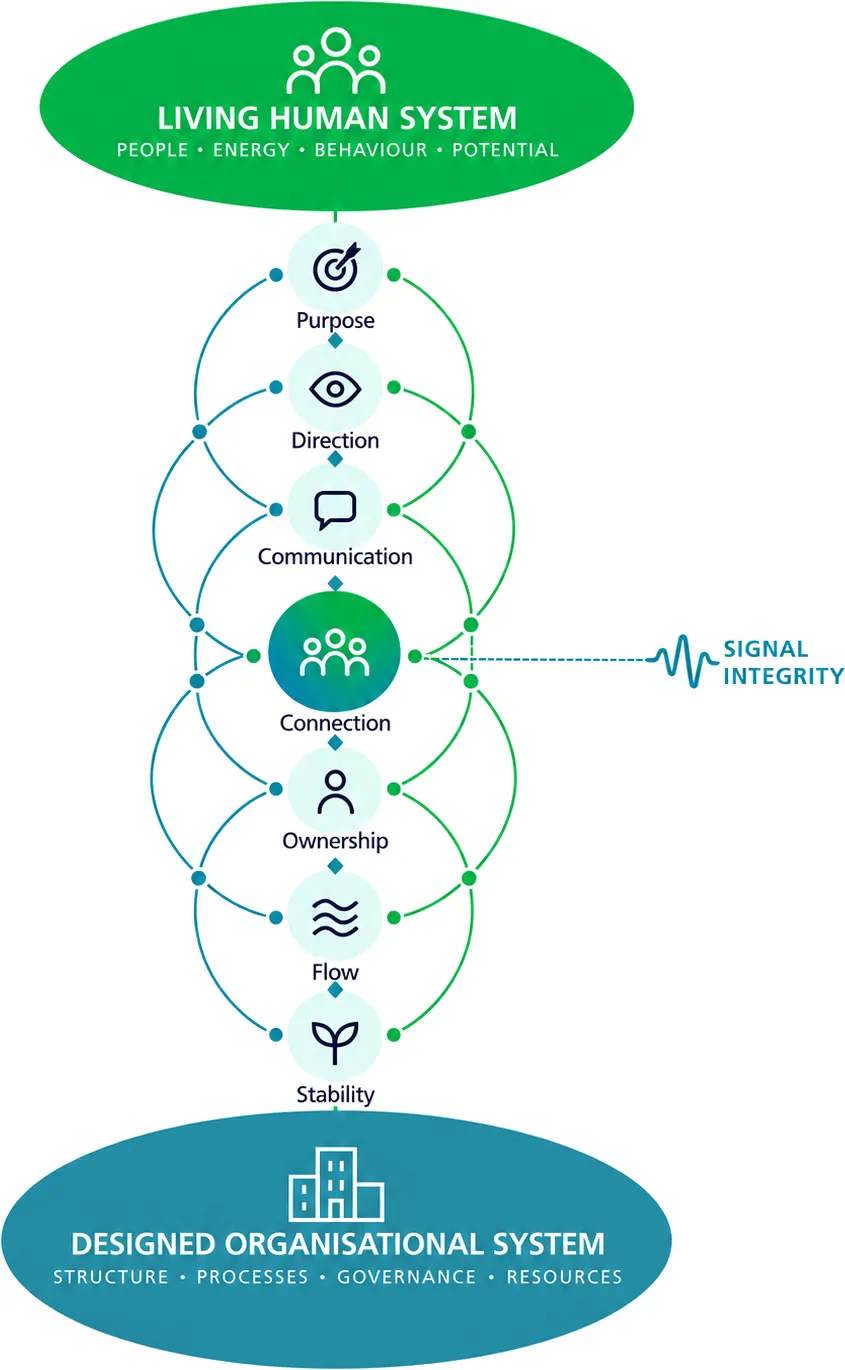
The NeO Frequency model: the Living Human System at the top and the Designed Organisational System at the bottom, linked through seven organisational conditions (Purpose, Direction, Communication, Connection, Ownership, Flow and Stability), with Connection at the centre and Signal Integrity running through it.

Connecting the dots

Two interacting systems. Seven interdependent organisational conditions.

The Designed Organisational System and the Living Human System continuously influence one another through Stability, Flow, Ownership, Connection, Communication, Direction and Purpose.

Connection sits at the centre of this model, reflecting and shaping the relationships through which information, decisions, feedback and collective action flow.

How Organisational Coherence emerges

When organisational structures and practices support people’s capacity to contribute, and people’s experience informs how the organisation operates, both systems reinforce one another. Shared direction becomes coordinated action, while feedback supports learning and adaptation.

SID™ uses this framework to compare how people at different organisational levels see and experience the organisation, helping identify what needs attention.

Business value

Greater Organisational Coherence helps people direct their effort towards shared priorities, make decisions that hold across teams and respond to change together. Less capacity is spent compensating for conflicting demands, leaving more available for execution, learning and adaptation. These conditions support resilient, sustainable performance.

How the concepts connect

Organisational Coherence emerges when the Designed Organisational System and the Living Human System reinforce one another. Signal Integrity describes how clearly meaning, direction and feedback travel through the organisation. Human Capacity describes what people can bring to their work and how their everyday experience supports or depletes that capacity. Both help explain what supports or undermines Organisational Coherence and the organisation’s capacity for sustainable performance.

A flock of birds moving together above a wetland.

Organisational Coherence Essays & Insights

How Organisations Become Intelligent

Why do organisations filled with intelligent people still make fragmented decisions? Because individual intelligence does not automatically become organisational intelligence. This essay explores how Organisational Alignment and Signal Integrity must reinforce one another for coherence to emerge, and how coherence makes distributed intelligence collectively available.

5 min read

Overlapping waveforms interfering with one another

Signal Integrity Essays & Insights

Communication Breakdown: It is the System Talking

Communication does not break down because people lack intent or capability. It breaks when signal integrity fails between intent, decision and action. What looks like conflict, misalignment or poor listening is often something else entirely: interference.

4 min read

Signal Integrity cannot be assumed. It must be measured.

SID™ reveals where organisational intent holds, where it loses strength and what needs attention first.